
Grandfather Clocks
-

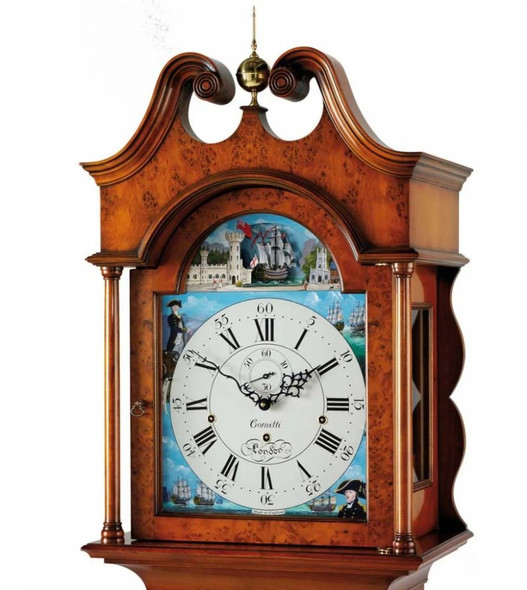
Trafalgar Grandfather Clocks C2408TCH
Comitti Clocks
$19,999.00Regency elegance inspired the scroll-top cabinet of the Trafalgar. The solid cherry cabinet is decorated with book matched burr yew veneers inlaid with "rope" edgeline. The clock features a hand-painted dial commemorating the Battle of Trafalgar in 1805...$19,999.00 -

Chatsworth Grandfather Clocks C2209TCH
Comitti Clocks
$19,500.00A Georgian-style break-arch case typical of the work of the London maker William Webster, circa. 1710. The Chatsworth cabinet is decorated with book-matched burr walnut veneers inlaid with satinwood banding. The case features fluted quarter columns to...$19,500.00 -

Empire Grandfather Clocks C2011TCH
Comitti Clocks
$27,999.00A Chippendale style floor clock inspired by David Rittenhouse (PA), circa. 1780. The Empire has a solid mahogany cabinet with curl veneers and decorative carving. The scroll pediment is supported by fine lattice fretwork. The case stands on ogee feet and...$27,999.00 -
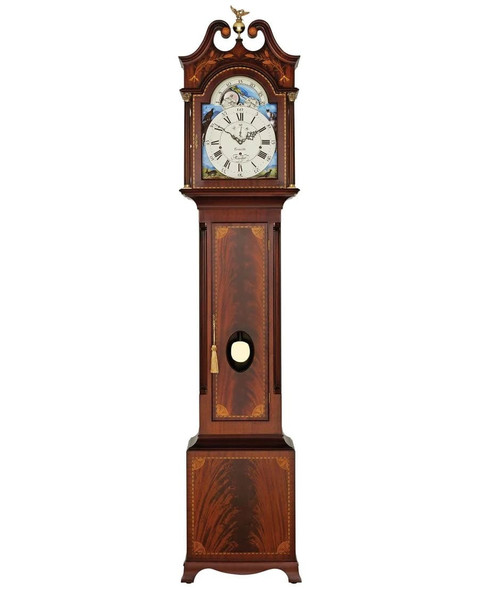
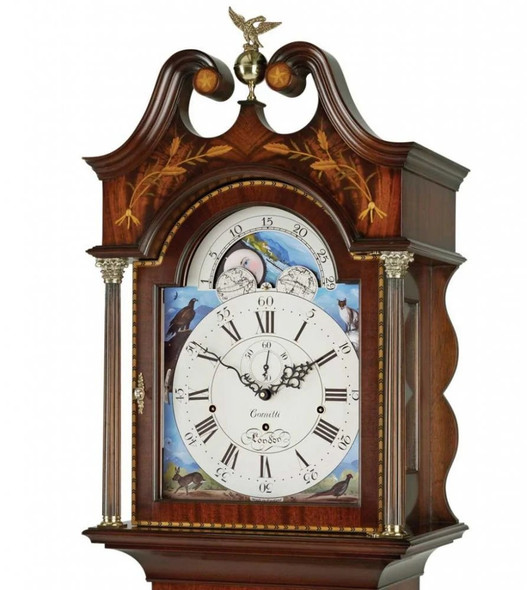
Gleneagle Grandfather Clocks C2002TCH
Comitti Clocks
$23,250.00The Gleneagle is a Sheraton-style grandfather clock inspired by the Scottish maker William Robb of Montrose, circa. 1790. Extensive use of checkered edgeline and marquetry inlays enhances the superb flame mahogany veneers of the Gleneagle. The scroll...$23,250.00 -

Vienna Grandfather Clocks C1201CH
Comitti Clocks
$21,250.00The Vienna has a Palladian-style walnut cabinet decorated with book-matched burr walnut veneers and figured walnut cross-banding. The Westminster chime movement features an enamel finish dial with Roman numerals and seconds indication. The time is...$21,250.00 -

Le Rose Grandfather Clocks 611-148
Howard Miller Clocks
$1,349.00Chimes quarter-hours & strikes the hours. Hampton Cherry finish on select hardwoods and veneers is lightly distressed for an aged appearance. This floor clock display cabinet features a flat-top pediment, a base with a decorative cutout, and is open...$1,349.00 -

Gavin Grandfather Clocks 610-985
Howard Miller Clocks
$4,449.00Chimes quarter-hours & strikes the hours. Traditional Howard Miller Gavin grandfather clocks 610-985 feature an arched bonnet pediment highlighted by a decorative shell and vine overlay. Finished in Oak Yorkshire on select hardwoods and veneers...$4,449.00 -
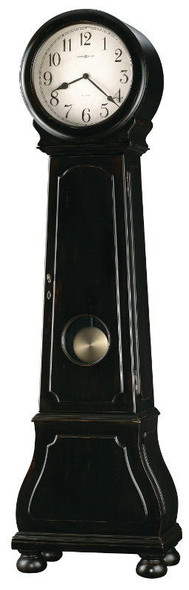
Nashua Grandfather Clocks 615-005
Howard Miller Clocks
$2,299.00Chimes quarter-hours & strikes the hours. Worn black finish on select hardwoods and veneers is moderately distressed for an aged appearance. Contemporary Howard Miller Nashua Grandfather Clocks 615-005 offer a distressed finish with a time-worn...$2,299.00 -

Urban II Grandfather Clocks 610-866
Howard Miller Clocks
$5,199.00Chimes quarter-hours & strikes the hours. These unique contemporary Howard Miller Urban II grandfather clocks 610-866 boast a simple, contemporary elegance. Finished in Espresso on select hardwoods and veneers. Simple lines best describe this...$5,199.00
Grandfather Clocks
Grandfather clocks, also known as floor clocks, are the patriarchs of timepieces. They sit or stand on the floor and are distinguishable from grandmothers by their taller size. Indeed, some can be as tall as 93 inches, such as some of the limited edition grandfather clocks. They are memorable heirloom timepieces that can make a great statement in any home or office. The most popular brand and models are Howard Miller grandfather clocks. Like most mechanical timepieces, grandfather clocks will usually have a case, pendulum, and weights, and some will play a melody. Although most have these traits in common, the style they're presented in can differ.
The clock case is the most apparent visual aspect. The traditional clock case usually has either a "box" case or a "pinch waist" design, such as some of the traditional grandfather clocks. The pediments can highlight the case with a swan neck pediment or a bonnet pediment. Additionally, a more contemporary look can include a flat top pediment or a round top, such as some of the contemporary grandfather clocks by Howard Miller. Access to the movement is usually made through the front, but some cases can have a removable hood.
Pendulums for the movement inside the case can be as simple as a wood stick pendulum or an elaborate lyre pendulum. Similarly, the weights can be simple and plain or decorative with matching weight bands. The inside of the case can also offer illumination, which allows the illuminated dial to be viewed in a darkened setting while the glow accents the pendulum, weights, and possibly even a moon dial.
Most mechanical grandfather clocks will offer a traditional chiming melody. Most will offer at least just the single Westminster chime, while others will offer a triple chime option, such as the presidential grandfather clocks. These mechanical chimes are usually played on metal rods. A particular limited edition clock of note is the J.H. Miller II, model 611-031, which plays the mechanical chimes on metal tubes instead of rods and will therefore produce a different sound. Visit our section on clock chimes for a complete overview of common clock chimes.
We showcase and feature some of the best brands on our online clock store and in our Wisconsin clock shop showroom, including Howard Miller grandfather clocks. Moreover, all Howard Miller grandfather clocks purchased in our online clock store come with free shipping anywhere within the Continental U.S. and free white glove in-home delivery. So browse these collections or let our experts help you find the "gift of time." As an Authorized Clock Service Center for some of the leading manufacturers in the world, such as Howard Miller Clocks, Ridgeway, and Sligh, our customers can be sure that we can provide the best in customer service and continuing technical service support on many Howard Miller grandfather clocks purchased from us.